
Objectives
- Know the names of the consonants
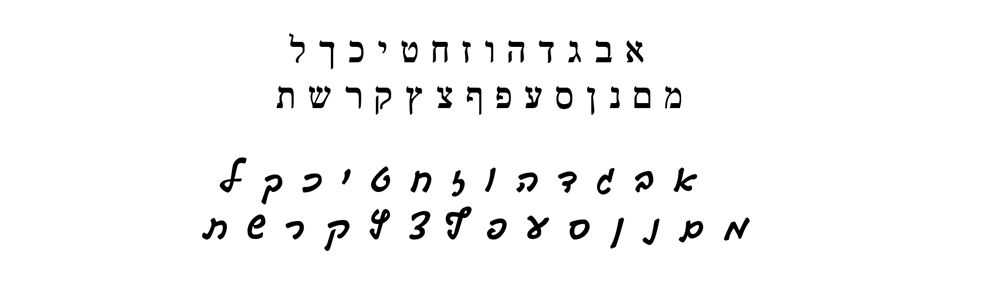
- Recognize the block and script forms of the consonants
- Write the script form of the consonants
- Pronounce the sounds of the letters
Observe How Letters are Written
The Hebrew alphabet is called the “alef-bet” (the Hebrew names of the first two letters; contrast with the Greek names for the first two letters “alpha” and “beta”). There are 22 letters in the Hebrew alef-bet and they are all consonants. (Vowels are represented using notations above and below the letters, and they will be introduced later.)
The following video shows how to write each letter, first in block form and then in script form. The block form is typically what books and other printed material use. The script form is typically what people use to write for themselves. Block form is like capital letters in English. Script form is like cursive letters in English. Script form is easier and faster to write, and thus it is more common for people to use day-to-day.
In the video, the name of each letter appears in the upper left of the screen. Watch the video below. Observe how many times you see duplicate letter names and what is common to the duplicates.
What do the duplicates have in common? Five of the letters have two versions. The first version is used when the letter appears in the middle of a word (i.e. there is a letter after it). The second version is used when the letter appears at the end of a word. The version that appears at the end of a word is called “sofit” [so-FEET], the final form.
Exercise – Practice Writing the Script Form of the Letters
Hebrew is written from right to left. Following the above video, write the script form of all 22 letters horizontally on a lined piece of paper. Do this at least 3 times in one sitting. Over the next week, do this 1-3x each day.
Exercise – Listen and Speak the Names of the Letters
Listen to this audio chant of the names of the letters and repeat it out loud until you can say it fluidly. Repeat this exercise daily for a week.
Exercise – Read and Write the Alef-Bet
- Write the entire alef-bet in script vertically down the paper. Say out loud the name of each letter as you write it.
- Examine Exodus 16:16 letter by letter, saying out loud the name of each letter. Note: Additional markings appear above, below, inside and next to the letters. These markings will be explained later. For purposes of this exercise, focus only on the letters themselves.
- In your vertically-written list of letters, circle each letter that you find in the verse.
- Repeat steps 1-3 for Zephaniah 3:8. Distinguish between final forms and non-final forms.
Note: These verses are called “pangrams” meaning that every letter of the alphabet appears in the verse. For more practice, repeat the above steps with these pangrams: Deuteronomy 4:34, Joshua 23:13, Esther 3:13
The Sounds of the Letters
The chart below shows the letters of the alef-bet, the name of each letter and the sound each letter makes.
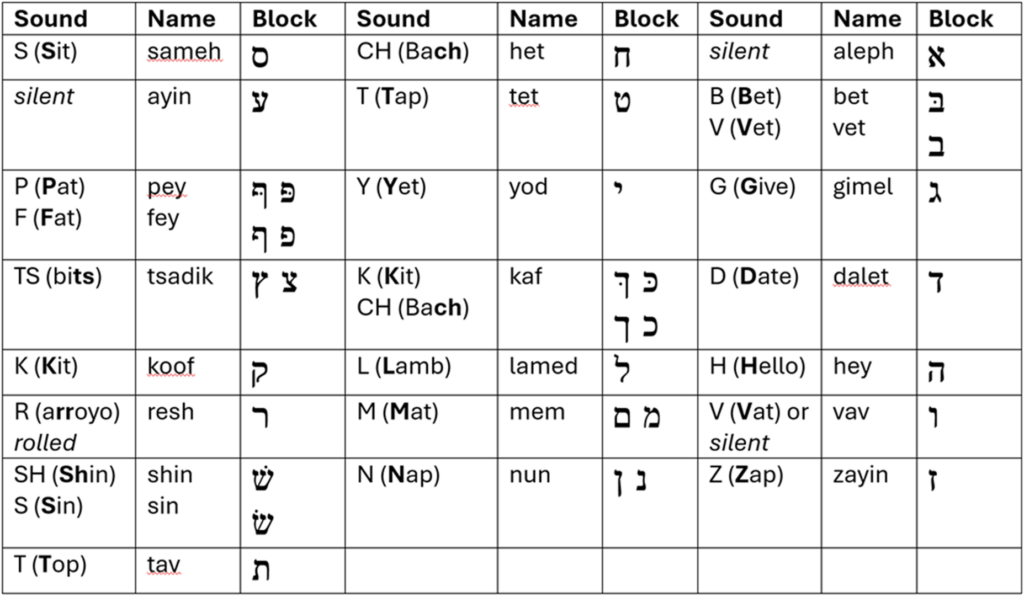
We already observed that five of the letters (kaf, mem, nun, pey and tsadik) have a different (final) form if the letter is the last letter of a word, but the sound is the same.
Four of the letters (bet, kaf, pey and shin) have a different sound depending on present or absence of a dot.
Ancient Hebrew letters originally held symbolic meaning. This series of short videos provides a brief history of the letters.
Resh
The “r” sound in biblical Hebrew is different from both modern Hebrew and English, but similar to the rolled “r” in Spanish (as Elon Gilad and Yoel Halevi explain). One evidence for this is that the Septuagint transliterates the resh in Sarah’s name with two rhos in Genesis 17:15:
| And God said to Abraham | Εἶπεν δὲ ὁ θεὸς τῷ Αβρααμ | וַיֹּאמֶר אֱלֹהִים אֶל־אַבְרָהָם |
| As for Sarai your wife | Σαρα ἡ γυνή σου | שָׂרַי אִשְׁתְּךָ |
| you shall not call her name Sarai | οὐ κληθήσεται τὸ ὄνομα αὐτῆς Σαρα | לֹא־תִקְרָא אֶת־שְׁמָהּ שָׂרָי |
| but Sarah shall be her name. | ἀλλὰ Σαρρα ἔσται τὸ ὄνομα αὐτῆς. | כִּי שָׂרָה שְׁמָהּ׃ |
Exercise – Read Transliterated Place Names
Open a map web site and set the language to Hebrew. (For Google Maps, click here to view the Hebrew place names. Click here to view the English place names.) Look at the Hebrew names of locations you are familiar with (e.g. countries, cities, U.S. states) and say the name you already know in English. Associate the consonant sounds with the Hebrew letters. The Hebrew place name will only show the consonants (alef-bet letters), not the vowels (covered in the next lesson). This is typical of modern Hebrew; the reader is expected to be so familiar with the words that they don’t need to be told what the vowels are.
Status Check
At this point, you know how to say the names of the consonants in Hebrew, how to recognize the block form of the letters, how to write the script form of each letter and the sound each letter makes. Next you’ll learn the names of the Hebrew vowels and how to combine consonants with vowels to produce a word.